Integrated local control
Use a site EMS controller with an optional built-in 7-inch touch display. Connect compatible solar inverters, battery systems, meters and generator controls through the selected equipment interfaces.
Two energy-control streams: an all-in-one EMS for small to medium behind-the-meter hybrid power systems, and tiered hardware with station software for larger grid-connected plants.
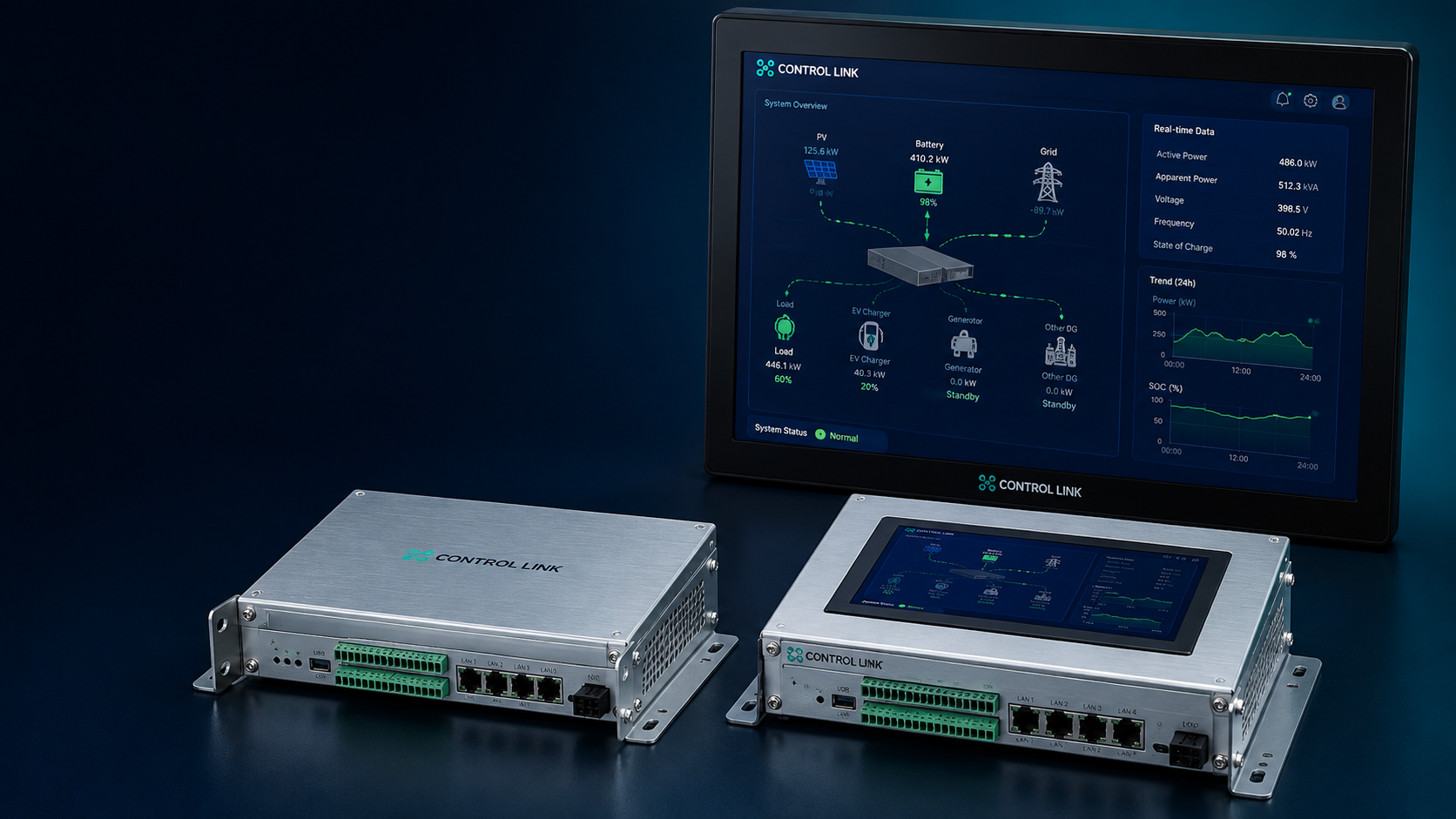
Bring site energy control, equipment data, local operation and cloud connectivity together in an integrated EMS. Built around the needs of commercial premises, industrial facilities and remote hybrid-power applications.
Use a site EMS controller with an optional built-in 7-inch touch display. Connect compatible solar inverters, battery systems, meters and generator controls through the selected equipment interfaces.
Configure solar self-consumption, battery charge/discharge schedules, peak-demand management and generator coordination around site priorities. Grid-connected and islanded operation depend on the complete system design.
Combine reusable configurations, AI-assisted programming and test preparation with remote visibility. Use historic and live data plus compatible regional electricity-price feeds to inform operating schedules.
All-in-one control, clearly scoped. The offering combines controller hardware and configured energy-management software, with local HMI and cloud options. Batteries, inverters, generators, switchgear and independent electrical protection form part of the wider project design.
Separate station supervision, equipment-group coordination and local execution to support larger storage and hybrid generation projects. Select hardware and software for the required plant functions and network interfaces.
Station-management software and a station control terminal provide plant-wide supervision, operating schedules and grid-dispatch interfaces. Configure the required power-control functions and operator views at this level.
Coordination controllers translate upper-level commands into power allocations across PCS groups and local controllers. Aggregate equipment feedback and coordinate scheduled dispatch across the plant.
Local controllers collect cabinet or container data and execute the coordinated charge/discharge commands at each energy-storage unit, alongside the equipment's own control and protection systems.
Conceptual architecture. Controller quantities, topology, communications and redundancy depend on the selected plant design; cloud analytics sit above the local control hierarchy.
For larger connections, start with the network requirements and the plant's intended operating envelope. Define measurable acceptance criteria for hardware selection, control behaviour, equipment interfaces and commissioning.
Agree grid-connection requirements, dispatch interfaces, active and reactive power duties, environmental ratings and required conformity evidence for the selected equipment.
Define the required engineering studies, configuration reviews and factory/site acceptance tests. Assess communications failures, equipment limits and interactions with plant protection.
Set requirements for traceable settings, test records, as-built documentation and controlled software changes to support commissioning and ongoing operation.
Compliance is confirmed for the complete installation. Grid-code conformity and connection approval depend on the selected equipment, plant design, studies, testing and relevant network authority. A controller alone does not establish compliance.
Match each controller to its role in the selected stream. Station-level hardware and project-specific interfaces are specified separately from the site EMS.
Coordinate solar, storage, grid and generator operation using configured site strategies. Available with an integrated 7-inch touch display.
Distribute energy-control commands across storage equipment and local controllers. Match dispatch interfaces and schedules to the project.
Collect cabinet equipment data and execute the coordinated operating commands needed by the selected energy-storage architecture.
| Processor / memory | Quad-core ARM, 1.8 GHz / 2 GB LPDDR4 |
| Storage | 8 GB eMMC + 256 GB SSD |
| Ethernet | 2 × 10/100/1000 Mbps WAN; 4 × 10/100 Mbps LAN |
| Serial / CAN | 8 × RS-485; 2 × CAN |
| Digital I/O | 16 digital inputs; 8 relay outputs (2 NC, 6 NO) |
| Other interfaces | 2 × USB 2.0; HDMI; TF slot; USB-C debug |
| Power supply | 12–36 V DC; nominal 24 V / 1 A or 12 V / 2 A |
| Operating environment | −20 to +60°C; ≤95% RH, non-condensing |
| Standard enclosure | 210 × 165 × 45 mm mainframe; approximately 1.4 kg |
| Touch enclosure | 210 × 165 × 53 mm; approximately 1.65 kg |
| Integrated touch display | Touch variant: 7-inch, 1024 × 600 |
| Connectivity note | Global variants require an external router for cellular/Wi-Fi |
The table above describes the site EMS standard and touch variants; it is not a common specification for every control tier. Dimensions describe the mainframe. Verify the mounting drawing, supplied variant, communications and market-specific conformity before ordering. Global variants use an external router for cellular or Wi-Fi connectivity.
Get the hardware PDF →Industrial panel displays bring equipment status, energy flows, alarms and trends to the operator. Select a 10.1-inch or 15.6-inch touch display to suit the panel.
Illustrative Control Link interface. External HMI displays require a compatible controller or host.
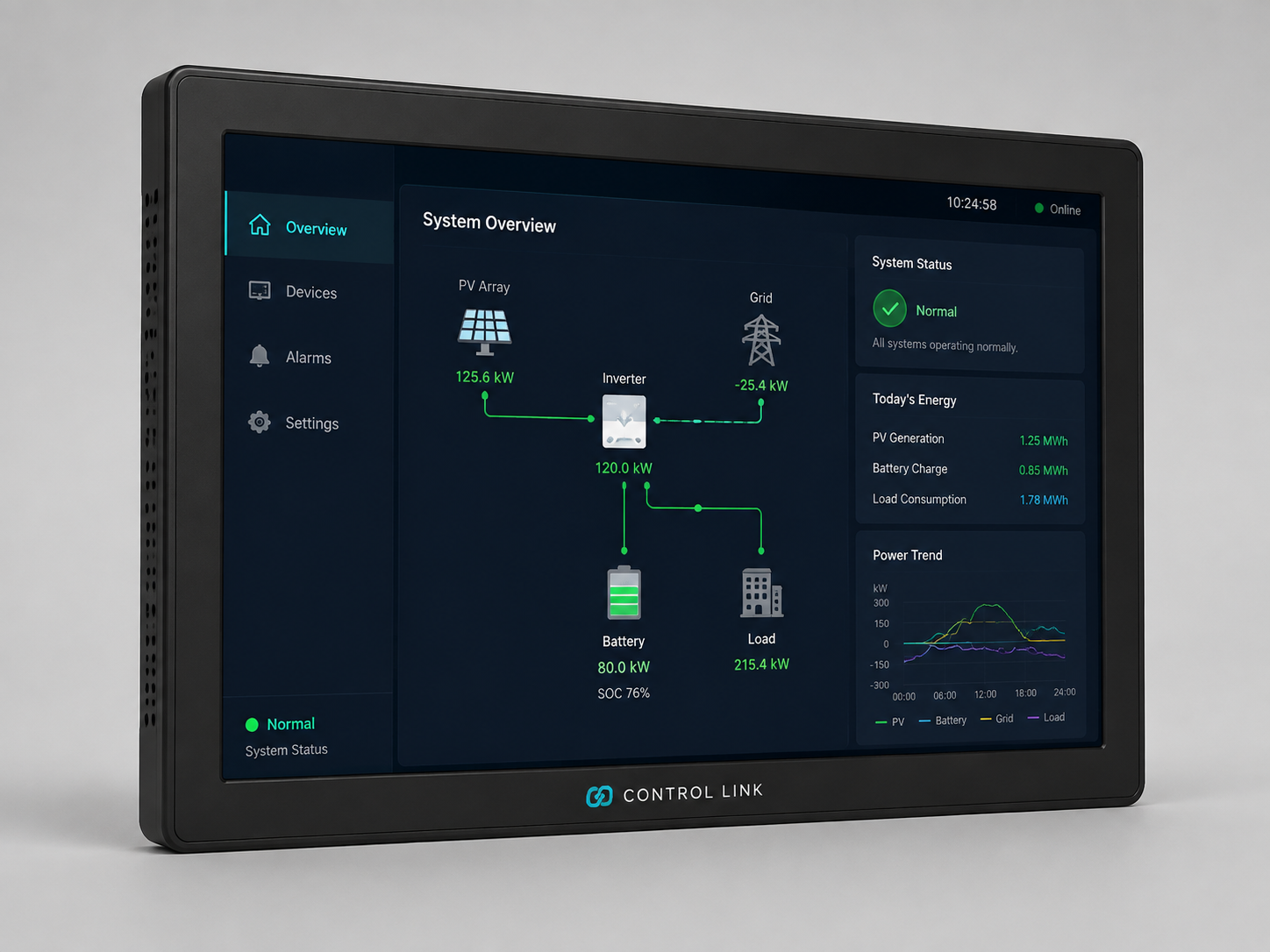
| Display | 10.1-inch | 15.6-inch |
|---|---|---|
| Resolution | 1280 × 800 | 1920 × 1080 |
| Touch | 10-point capacitive | 10-point capacitive |
| Brightness / contrast | 250 cd/m² / 1000:1 | 250 cd/m² / 1000:1 |
| Connections | HDMI, VGA, USB touch | HDMI, VGA, USB touch |
| Dimensions (mm) | 262.8 × 174.8 × 38.5 | 393 × 241.9 × 44 |
| Operating temperature | 0 to +55°C | 0 to +55°C |
| Front protection | IP65 front panel only | IP65 front panel only |
| Power | 12 V adapter; optional 24 V version | 12 V adapter |
| Rated consumption | 20 W | 20 W |
IP65 applies to the front panel only. The optional 10.1-inch terminal-input version is rated for 12–48 V DC, nominal 24 V. Verify cut-out dimensions using the approved drawing.
Keep the operating picture connected, from the local HMI through station management to the cloud.
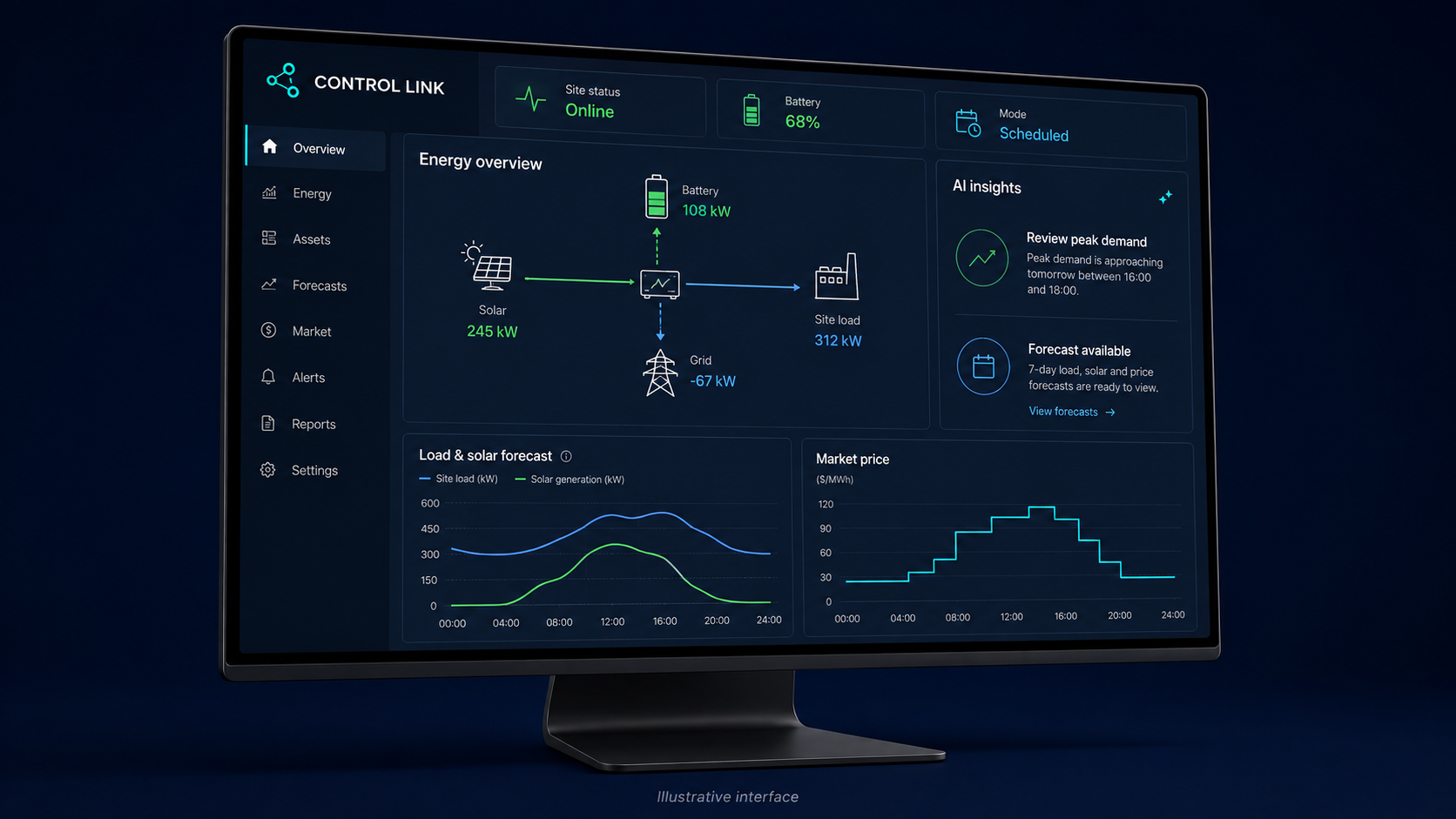
| Local EMS & HMI | Device monitoring; PV, battery, grid and generator coordination; configurable energy strategies; alarms, trends and equipment status. |
| Station management | Centralised site views, topology and strategy configuration, device/cell monitoring, permissions, alarm history and operational reporting. |
| Cloud platform | Fleet dashboards, historical data analysis, alarm and event investigation, asset/O&M management, reporting and mobile access. |
| AI forecasting & optimisation | Load and solar forecasting; energy-storage scheduling optimisation; electricity-price forecasting and a knowledge-based assistant in supported configurations. |
| Deployment | Local operation and cloud-connected management are separate layers. Hosting, licensing, data retention and interfaces are agreed for each deployment. |
| Capability | Detailed function |
|---|---|
| Equipment visibility | Views for solar, storage, PCS, BMS, generators and EV charging where compatible equipment is connected. |
| Battery insight | Pack/cluster operating values, cell voltage and temperature views, and battery condition indicators. |
| Operating strategies | Scheduled charge/discharge, self-consumption, demand management and backup priorities, subject to the selected site architecture. |
| Alarm management | Current and historical alarms, configurable templates, suppression and notification settings. |
| Historical data | Trend views, list queries, configurable data columns and export of historical equipment information. |
| Reporting | Energy, revenue, battery state-of-charge, power, temperature and voltage reports with configurable grouping. |
| Operations audit | Category-based operating logs and event histories to support investigation and engineering review. |
| Tariff configuration | Regional and custom tariff templates, with strategy parameters configured for the target market. |
| Cloud communications | MQTT-based site reporting and command exchange in the documented cloud architecture; compatibility agreed per deployment. |
| User access | User, tenant and role-based permissions, with configurable menus and system parameters. |
| Fleet maintenance | Central site views, asset records and work-order management for operating teams. |
| International operation | Language and time-zone configuration. Market feeds, hosting and data policies agreed for each region. |
| Engineering assistance | Control Link AI assistance for programming, test preparation and review, supported by engineer validation. |
| AI energy optimisation | Load and solar forecasting, historical/live-data analysis, price-aware scheduling and configured operating constraints. |
Configured for your project. Agree supported devices and protocols, hosting region, data retention, licensing and local/cloud responsibilities before deployment.
Use AI assistance for programming, test preparation and review. Combine reusable configuration with engineer-reviewed suggestions to reduce avoidable errors.
Analyse historical consumption and live equipment information alongside solar and load forecasts to inform operating strategies.
Connect compatible regional tariff and spot-price feeds to support storage scheduling, peak-demand management and operating-cost optimisation.
AI tools and market-data connections are configured for each deployment. Confirm regional feed coverage and supported engineering tools with Control Link. Site constraints and equipment protections remain part of the commissioned design; savings depend on actual operating conditions.